Single-layer or multi-layer: why material decides your refinements
All aligners look the same. The difference sits in how the material is built up, and that difference decides how much force is left after a week.
7 min read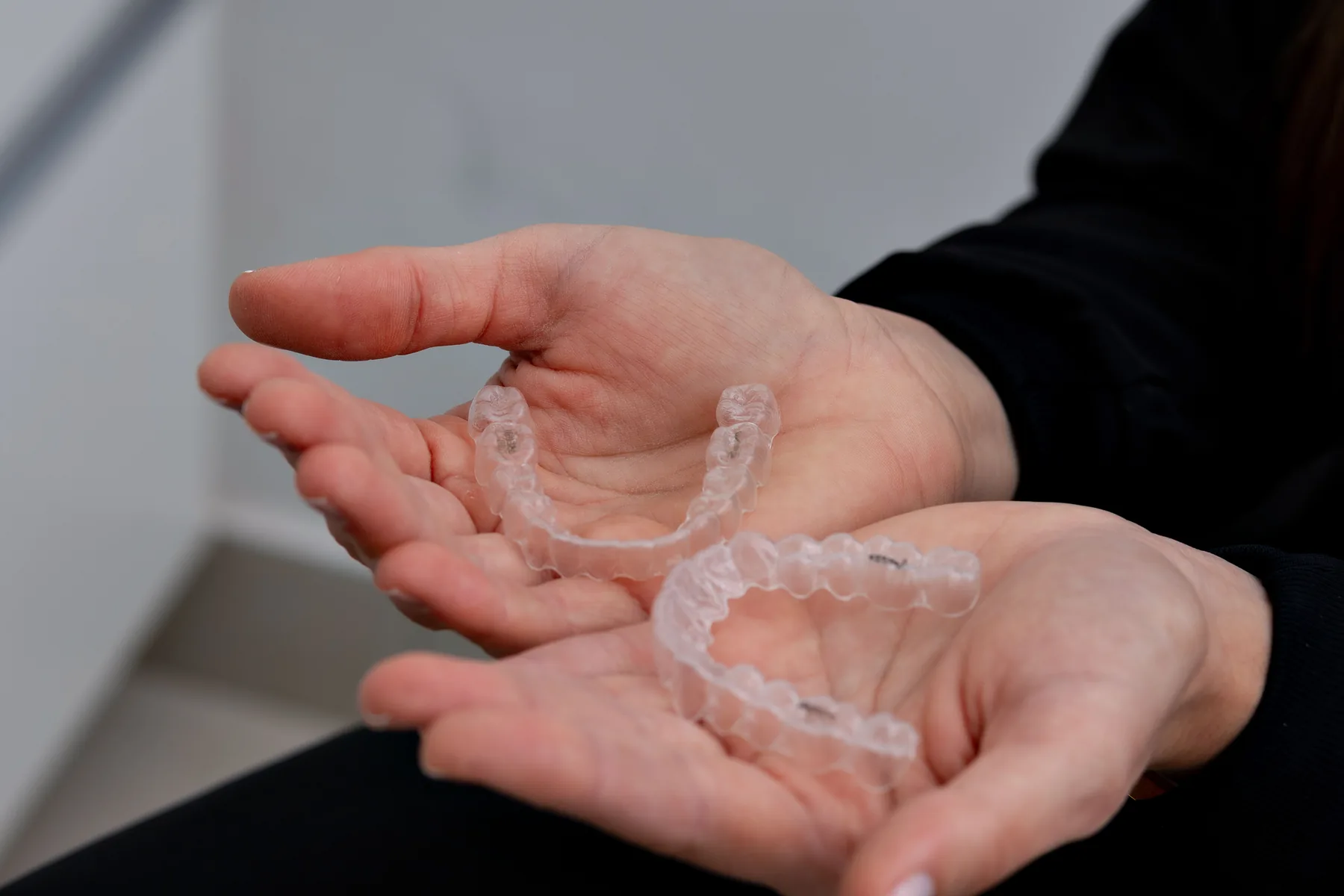
Why two aligners that look identical behave differently
Put two aligners side by side and you see no difference. Both are clear, thin and made to measure. Yet they can behave very differently in the mouth, and that difference sits in something you cannot see: how the material is built up and the way it was formed.
For the patient that shows up as comfort. For you it shows up as the number of cases that drift from the plan.
What an aligner actually does
An aligner works by creating a difference between where the tooth is and where the aligner wants it. That difference puts tension on the material, and that tension is converted into a light, sustained force on the tooth.
Two things matter there.
The initial force is the pressure at the moment the patient seats a new set. It has to be large enough to get movement going, but not so large that it becomes unpleasant.
Force retention is what is left after a few days. Polymers show relaxation: under sustained load the tension drops. In an aligner that means the pressure on the tooth falls the longer the set is worn.
That second point is where materials really diverge, and it is also the point that gets discussed least.
The problem with single-layer material
In a single-layer sheet, one material has to deliver every property at once: enough stiffness to exert force, enough elasticity to slide over the teeth, and enough stability to hold that force.
Those properties work against each other. More stiffness gives a higher initial force but also a harder aligner, which fits less comfortably and relaxes faster. More elasticity gives comfort but less control.
The practical consequence: the force peaks in the first days and then falls away. If your patient wears a set for two weeks, the second week does less clinically than the first. The tooth moves further on paper than in reality, and that gap compounds across the sets.
What multi-layer material does differently
Multi-layer material consists of several layers, each with its own job. A stiffer layer delivers the force, a more elastic layer provides comfort and recovery. By separating those tasks you no longer have to trade them off.
The main consequence is force retention. Optimal Aligners aligners hold their force for longer than seven days. That means a set worn for two weeks keeps working across that whole period instead of slackening after a few days.
The second consequence is comfort. Initial forces are 40% lower than with conventional material. For the patient that is the difference between a new set that feels tender for two days and a new set you barely notice.
Why comfort is a clinical argument
Comfort sounds like a patient argument, but it is first of all one of yours.
An aligner only works when it is worn, 20 to 22 hours a day. The moments when patients deviate from that are predictable: the first days of a new set, when the pressure is highest. Anyone who skips an evening then, and again on the next set, builds a backlog you see later as tracking that does not follow.
Lower initial forces take exactly that moment away. That is not a comfort claim but a compliance argument, and compliance is the factor that most strongly determines your treatment result.
Production: why pressure and layer thickness matter
Material alone is not enough. How the aligner is formed determines how closely it fits.
Thermoforming at 8 to 10 bar. In thermoforming, the heated sheet is pressed over the model. The pressure used determines how faithfully the sheet follows the anatomy. At lower pressure, microscopic deviations remain, particularly in the places that matter most: around attachments, at the incisal edges and in the interproximal spaces. Higher pressure gives an aligner that fits more closely, and a closer fit gives more predictable force transfer.
Print layers of 70 micron. The aligner is formed over a printed model. The layer thickness of that model determines how finely the anatomy is reproduced. With coarser layers you get a stepped surface that the aligner copies. At 70 micron that stepping is small enough to be clinically negligible.
So neither figure refers to the aligner itself but to the route towards it. Together they determine how close the end result sits to the digital plan.
What that means for your schedule
The link between material and practice management runs through one number: the refinement rate. That is the share of treatments needing extra aligners because the result drifted from the plan.
At Optimal Aligners that number is 15.8%, well below the market average.
Convert that into your schedule. Every refinement means a new scan, an adjusted plan, another production round and at least one extra appointment. The treatment runs longer, the patient gets more impatient, and the time you put into it was never budgeted.
A lower refinement rate is therefore not a technical detail but the difference between a treatment that closes as planned and one that overruns.
What you can control yourself
Material is one half. The other half sits in the scan and the follow-up.
- Make sure attachments are placed correctly and check engagement when in doubt
- Point your patient towards chewies: they seat the aligner fully and improve the fit
- Discuss from the start that 20 to 22 hours a day is not a guideline but the condition
- Warn about the most common mistake: using hot water to clean, which permanently deforms the polymer
That last point is surprisingly often the explanation behind an aligner that suddenly no longer fits.
In short
All aligners look the same, but they do not behave the same. Multi-layer material separates force and comfort instead of trading them off, and holds its force for longer than seven days. Combined with thermoforming at 8 to 10 bar and print layers of 70 micron, that gives an aligner that stays closer to the plan.
What you notice of that, you will not see on the aligner. You will see it in the number of cases you do not have to correct.